Filing a Dutch VAT return: how it works for SMEs
In the Netherlands you usually file your VAT return every quarter; the tax authority (Belastingdienst) can also allow or require a monthly or annual return. You must file and pay no later than the last day of the month after the period. In the return you report the VAT you charged your customers, and you deduct the input VAT: the VAT you paid yourself on business costs.
By Redactie Nexora
When do I file a VAT return?
The standard is a quarterly VAT return. The Belastingdienst can also allow or require a monthly or annual return. The tax authority tells you which period applies to you.
Even if you had no turnover in a period, you still file a return. This is called a nil return. If you file or pay late, the Belastingdienst can impose a penalty.
When do I have to pay?
You must file and pay no later than the last day of the month after the period. The money must have reached the Belastingdienst by that day.
- Quarterly: the first quarter by 30 April, the second by 31 July, the third by 31 October and the fourth by 31 January.
- Monthly: by the last day of the following month, so for March by 30 April.
- Annually: by 31 March of the following year.
What is output VAT?
Output VAT is the VAT you charged your customers in a period. You report that amount in the return. The rate you charge depends on what you supply:
- 21% is the standard rate, for most products and services.
- 9% applies to food and books, among other things.
- 0% applies to exports outside the EU, among other things.
Exempt is not the same as 0%. With an exemption you charge no VAT, but you may not deduct the VAT on your own costs either. With 0% you may.
What is input VAT?
Input VAT is the VAT you paid yourself on business purchases and costs, such as software, a laptop or the rent for your business premises. You deduct that VAT from the output VAT, so you only pay the difference.
You may only deduct VAT on business purchases and with an invoice that meets the requirements. Private expenses do not count, and neither does VAT on purchases you use for exempt supplies.
How do I calculate the amount I owe?
You deduct the input VAT from the output VAT. If the result is positive, you pay that amount. If the input VAT is higher, you get the difference back.
An example with round numbers: in a quarter you charged €1,000 in VAT and paid €400 in VAT on your purchases yourself. You then pay €1,000 − €400 = €600.
What if I paid too much or too little?
If you find a mistake in an earlier return, you correct it. If it concerns more than €1,000 in VAT, you do so with a supplementary return (suppletie). A smaller difference may be included in your next return.
In the supplementary return you state how much VAT you reported too much or too little. If it was too little, you pay the difference. If it was too much, you get it back.
Example: TechStart Solutions
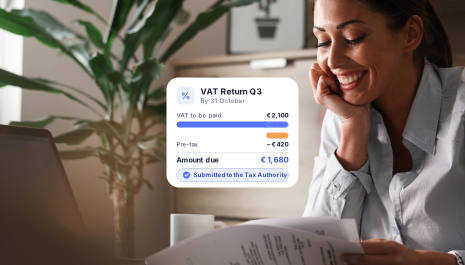
In the third quarter, TechStart Solutions invoiced €10,000 to customers, with 21% VAT. On that, the company charged €2,100 in VAT. In the same quarter it bought hardware for €2,000, with €420 in VAT.
- Output VAT: €2,100
- Input VAT: €420
- To pay: €2,100 − €420 = €1,680, by 31 October
How it works in Nexora
In the Accounting module your sales invoices, purchase invoices and bank transactions come together. You send purchase invoices to your administration's own e-mail address, and Nexora proposes a booking with the VAT code. Nexora prepares the VAT return from the same bookings.
- You review the return and approve it; it then goes to the Belastingdienst automatically.
- Nora answers questions about your figures in plain language, with the source included.
- The VAT return is included in every plan.
Read more about Accounting in Nexora.
Frequently asked questions
How often can I file a supplementary VAT return?
What if my turnover is zero?
Can I correct a mistake in an earlier return?
Is an exemption the same as zero percent?
Where can I find the current rates?

Business operations that think along with you.
Let us show you in 30 minutes where Nexora can create calm, control and momentum straight away.